Written and compiled by Jason Mattes
Almost two and a half months into 2026, and commodity markets have already experienced a significant amount of volatility and uncertainty. This is especially the case during times of disrupted supply chains, geopolitical friction, wars and socio-economic turmoil. Adverse events such as these may include strikes at major mines and disruptions to major sea routes that negatively affect the availability of raw materials.
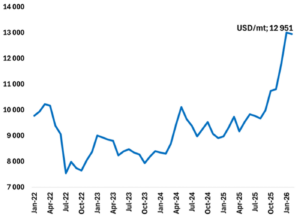
However, even before the start of 2026, there was already a lot of uncertainty regarding the state of the world’s two largest economies, China and the US, which ultimately affect supply and demand, and therefore prices. This is especially the case with respect to copper, which is a good indicator of global economic health as it is important in almost every facet of our lives and is likely to remain so, especially with the growth of electric vehicles (EVs) and in artificial intelligence infrastructure. The uncertainty and volatility is reflected in the copper price, which Figure 1 below shows keeps on hitting new highs.
FIG. 1. THE PRICE OF COPPER (JAN 2022 – FEB 2026)
Situations exhibiting economic uncertainty and commodity price volatility affect almost everyone, in particular recyclers, and especially such a key metal such as copper. The behaviour of copper is a practical example of the stresses and strains afflicting many other commodities.
Besides the uncertainty and volatility, there is a supply deficit for copper that is expected to persist, which will only send copper prices higher (barring a severe downturn). A major effect of higher prices is to promote substitutes for copper, either natural such as aluminium or alternative materials such as fibre optics and carbon nanotubes (CNTs) shown in Figure 2 below, which are mainly in the research phase at present.
FIG. 2. CARBON NANOTUBES (CNTS)

The search for and use of substitutes for existing metals to overcome supply shortages, increased demand and higher prices, affects recyclers. In such a world, the availability of scrap and the recycling industry’s role in its production becomes ever more important as a source of metals such as copper to help close supply deficits.
As a result, it is of rising importance for recyclers to be able to recover a commodity that is in demand in the largest amount possible in the most efficient and optimal manner via cleaner separation techniques that help ensure the recovered metal has the right density and consistency and is minimally contaminated.
This can be achieved by recyclers employing superior equipment for material handling, sorting, shredding and baling, in addition to any manual sorting techniques that are used, which will also help overcome additional costs and tighter margins recyclers might face in the pursuit of improved recovery rates. All of these efforts will lead to improved efficiency, optimise the recycling process and boost recovery rates, ultimately yielding higher profit margins.
Higher recovery rates are therefore critical at times of disrupted and volatile commodities markets. Now, more than ever before, recyclers have the opportunity to increase the availability of scrap and establish themselves as reliable suppliers of metals such as copper that are in high demand.
It will also take time to scale up alternatives such as CNTs, ensuring recyclers can position themselves as reliable suppliers in the meantime. Even when alternatives become viable, recyclers will still play a central role in the supply and recycling of materials.
Therefore, enterprises that invest in efficient material handling, sorting and processing equipment are likely to be better positioned to survive volatile markets and maximise recovery rates.
At SUD Recycling Equipment Solutions, we work closely with recyclers to help optimise these processes and are here to support your business.
Contact us on +27 82 326 8898 or email info@sudrecycling.com.
SOURCES
- OECD – Global Scrap Steel Market
- GIS Reports – Global Copper Supply Under Stress
- Global Ardour – The Effect of Mining Strikes on Scrap Metal Prices
- IEA – Copper Prices Have Hit Record Highs
- IMDEA Materials – Global Copper Crisis: Do We Have Alternatives?
- Rice University – Carbon Nanotube Research
- World Economic Forum – Recycling Metal Opportunity